




There had been constant pressure on India from developed nations like the US to raise its climate ambitions and commit to a net-zero target by 2050.
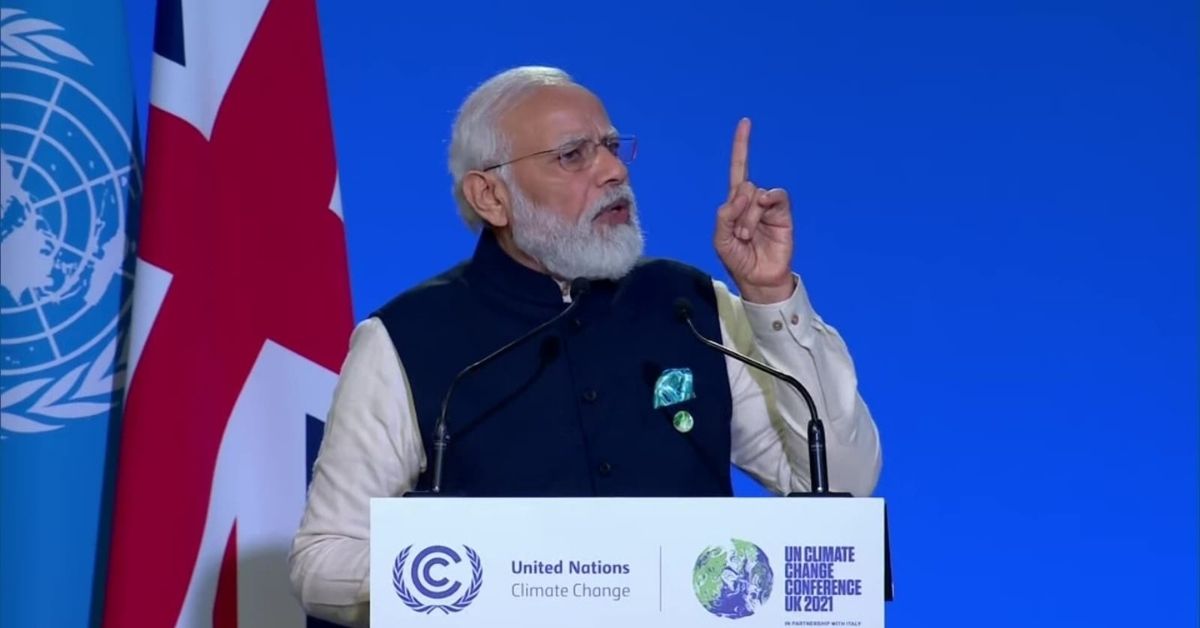
India is working towards achieving net-zero emissions by 2070, Prime Minister Narendra Modi said in Glasgow Monday, November 1, while announcing India’s new climate commitments.
He spoke at the ‘High Level Segment for Heads of State and Government’ during the UNFCCC’s 26th Conference of Parties (COP).
Post much anticipation; the net-zero commitment is among five new climate change targets Modi announced at the climate summit.
The Indian government had never spoken about its takes at the COP26 and had always maintained that by 2050 a net-zero target was off the table despite pressure from developed countries.
The commitment is significant as India is the third-largest user of carbon dioxide in the world, after China and the US. Net-zero means to be removing as many emissions of carbon dioxide from the atmosphere as produced.
Gift of Panchamrit
He called them “gift of five elixirs” (panchamrit); PM Modi announced India’s four other commitments — all by 2030.
- To Increase the non-fossil energy capacity to 500 gigawatts (GW)
- Attaining fifty per cent of energy requirements from renewable sources
- reducing the carbon intensity of an economy by 45 per cent
- Reducing overall forecasted carbon emissions by 1 billion tonnes
“These five elixirs will be an unparalleled contribution by India towards climate action,” Modi said at the summit.
Modi said India expected developed countries “to make $1 trillion available as climate finance as soon as possible” to achieve its climate goals.
The PM also outlined the other activities that will help India achieve these goals, namely the Indian Railways’ commitment to net-zero by 2030 and its ambition to install 450 GW of renewable energy capacity.
The PM described the International Solar Alliance, launched with the French government in 2015, as an “a revolutionary step to develop solar power” and said the Coalition for Disaster Resilient Infrastructure — an organisation launched by the Indian government in 2019 — was “an important and sensitive initiative which will help to save millions of lives”.
Put Pressure on Countries that Haven’t Lived up to Commitments
Before the summit, India had been under pressure from developed states like the US to raise its climate ambitions and commit to a net-zero target by mid-century.
During his speech, Modi also called out developed countries for failing to deliver on climate finance. “As we are all increasing our ambition with respect to climate action, the world’s ambitions with respect to climate finance cannot be at the same level as they were at the Paris Agreement,” he said.
“Justice will truly be served if we put pressure on those countries that have not lived up to their climate finance commitments. Today, India is moving forward with much courage and ambition,” he said.
Climate Adaptation
PM Modi also spoke at the ‘Action and Solidarity’ presidency event. He said climate adaptation hadn’t generated enough global debate, resulting in an “injustice to those developing nations that are more impacted by climate change, like India”.
Citing schemes on tap water and clean cooking gas, he said climate adaptation should be at the centre of all developmental plans and policies, and “traditional” knowledge on how to adapt to climate change should be respected and passed on from generation to generation.
“Even if the adaptation techniques are local, the support provided to vulnerable countries must be global.
Still Not New NDCs
It is unclear if the new commitments India announced will make it to its nationally determined contribution (NDC) as part of the Paris Agreement.
It is a legally binding, self-determined target that countries make to help slow climate change. As part of the Paris Agreement, signed at the 21st COP in 2015, countries must review and update their NDCs every five years.
In 2015, India made three pledges:
- An economy-wide emissions intensity target of 33–35 per cent below 2005 levels.
- An electric power capacity target of 40 per cent installed capacity from non-fossil-based energy resources by 2030.
- A carbon sink expansion target of creating an additional (cumulative) carbon sink capable of absorbing 2.5-3 gigatons of carbon dioxide equivalent through different forest and tree cover by 2030.
Of the 194 parties that signed the Paris Agreement, over 143 have updated their NDCs. India, however, hasn’t yet done so.