




Meghalaya’s “non-tribal issue” has been in the news for a long time now. It combats “decades of violence and atrocities” against Meghalaya’s non-tribal population.
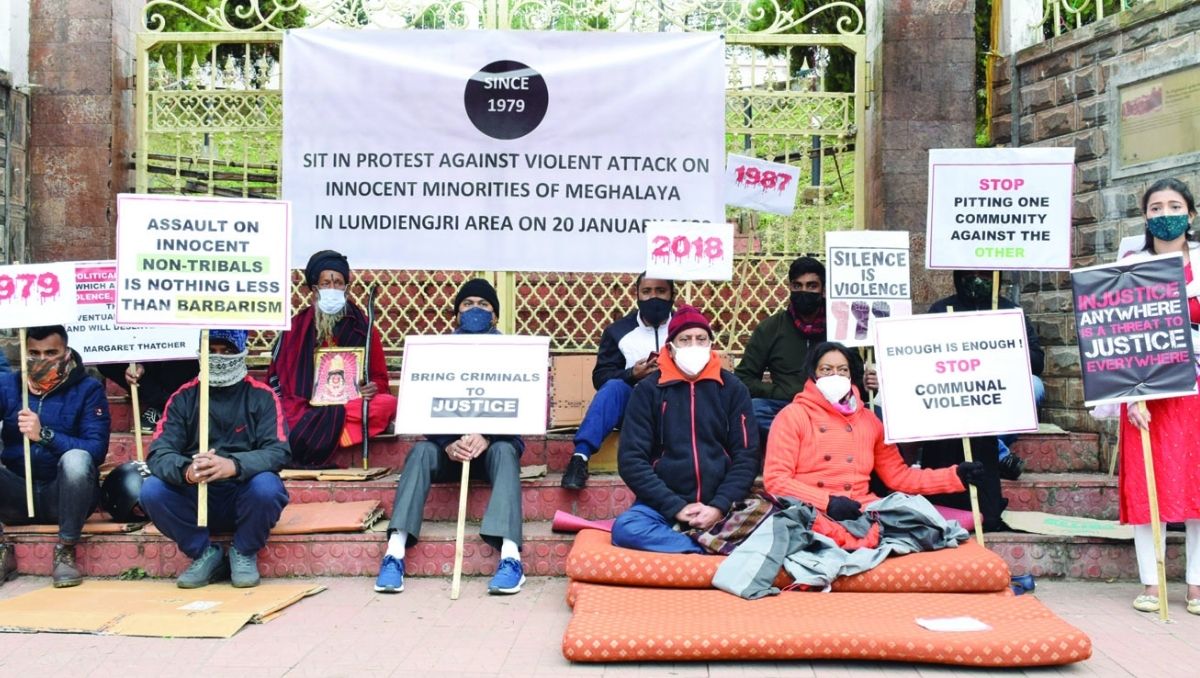
On Sunday, a couple from Shillong sat on a six-hour-long strike to protest the growing violence upon the non-tribals, mainly Bengali, Nepali, Bihari, etc. The protesters were Sushit Kanti (68) and Kalpana Choudhury (58), who came together on a silent protest in the heart of Shillong town.
Due to the act of violence meted upon the non-tribals on January 20, where “unidentified miscreants” assaulted a group of non-tribal people close to a police station in the town’s Lumdiengjri locality.
Under the purview of the East Khasi Hills district administration, the couple took permission to protest.
The placards they held were silent cries against the violence and attacks and the escalating hostility between the tribals and the non-tribals. Words like “Assault on innocent non-tribals is nothing less than barbarism”, “Enough is enough, stop communal violence”, “Stop hitting one community against the other” was written in bold letters.
Many tribal activists came forward to support the couple in their silent protest. Kalpana admitted that it was heartwarming to see the tribal activists’ support for solidarity.
Meghalaya’s Non-Tribal Issue; A look into the past
The history of the problematization of non-tribal migration is quite dense. According to the facts, it was in the 1970s that it became a major political issue. The root cause was the looming fear of a section of the indigenous tribes swamped by the non-tribal migrants.
The educated elites of the Khasi, Garo and Jaintia communities took responsibility for instilling the communal doctrines in the minds of the people who came from the rural population.
They were well educated, exposed to the Western ideals who spoke on behalf of the general masses while charging their communities with a need for a staunch ethnic identity.
It was after the formation of Meghalaya as a separate state that the educated elite started to problematize non-tribal migration forcefully and at the same time pursued ‘sons of the soil policy’.
According to this, the local people receive preferences in educational, employment and political opportunities, acquisition of land, and even in trade and business matters.
However, the term ‘local people’ does not apply to a person’s place of birth; instead, it is mainly related to the membership of a particular ethnic, religious or linguistic group.
Another turning point came with The Meghalaya Transfer of Land (Regulation) Act, 1971, which served the twin purposes. It was to prevent the alienation of tribal lands to non-tribals and reclaim the lost ground.
However, the significance of the ‘sons of the soil policy’ is that it safeguards the tribals’ further marginalization as the indigenous tribes of the northeast remain the vulnerable section in a vast country like India.
The land plays a crucial role in the lives of the tribals from the economic, social and political perspectives. The duality of the conflict is high on the rise but does it justify the atrocities meted against the innocent non-tribals almost regularly?
Shillong Couple Protest; a conclusion
The message that he wants to give out through the silent protest is “to bridge the gap between the tribals and the non-tribals.” The protestor Sushit is a businessman who was born and brought up in Shillong in the 1930s from Sylhet.
Kalpana, his wife, was born in Shillong and supported her husband, questioning the animosity. He said, “This is the only home we know”. Agnes Kharshiing, a prominent social activist too, came forward and said, “In our state, we follow the philosophy of ‘Tip brew tip Blei’, which means we have to respect each one.”
But in a world full of divisions, wars and immigration, the question is can two communities live as one? The ego plays a significant role, and how can it easily be defeated?
Published By – Vanshu Mehra
Edited By – Subbuthai Padma