




Table of Contents
When we try to measure how fast the universe is expanding, the measurement depends on from which side of the universe you will start. A new revolutionary study by the EPFL’s Institute of Physics has measured the Hubble’s Constant to a very unprecedented accuracy, which shed new light on the Hubble Tension, ie the Hubble constant discrepancy.
We know that the universe is expanding, but how fast exactly? The answer to this question depends on whether you measure the cosmic expansion rate – Hubble’s constant, or H0 based on the echo of the Big Bang ( i.e the Cosmic Wave Background or CMB ) or by measuring the H0 based on today’s stars and galaxies. This problem is known as Hubble’s Tension and it has perplexed physicists and astrophysicists around the world.
A study led by Richard Anderson of EPFL’s Institute of Physics in collaboration with Stellar Standard Candles and Distance research group adds a new piece of important information to the puzzle.
Their study/research published in the Journal Astronomy and Astrophysics has achieved the most accurate measurement of Cepheid Stars, which is a type of Variable star whose luminosity fluctuates over a defined time period, for distance measurements to date based on the data that has been collected by the European Space Agency’s (ESA) Gaia Mission. This new measurement further amplifies Hubble’s tension puzzle.

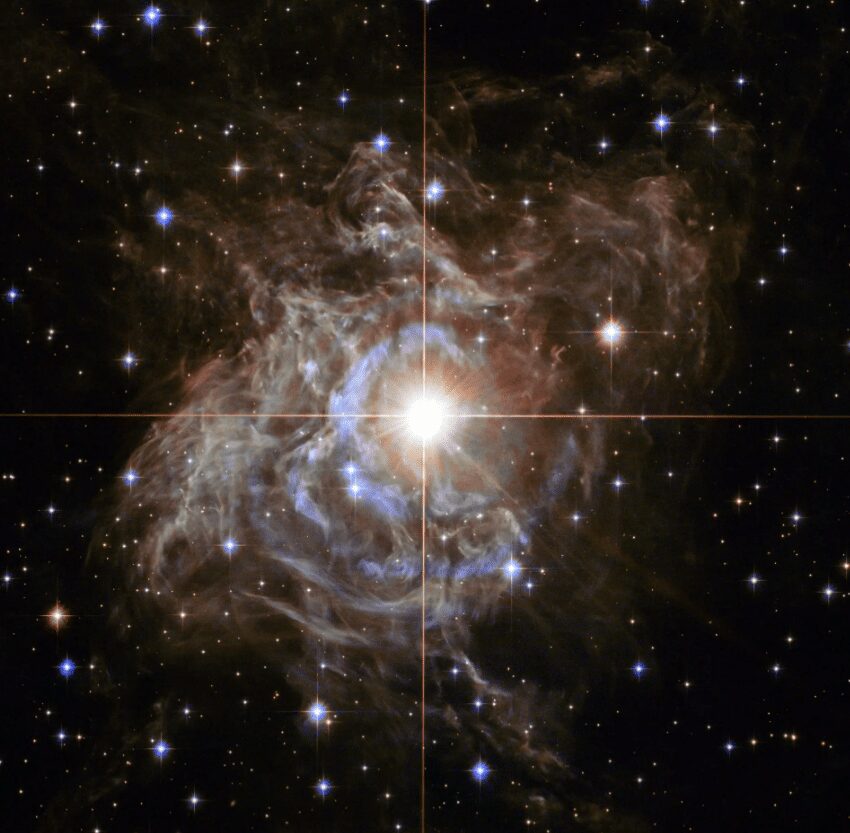
The above image shows a type of variable star known as the Cepheid Variable namely RS Puppis. Considering the Variable stars, the Cepheid Variable stars have comparatively long periods. RS Puppis for example fluctuates in brightness by a factor of 5 every 40 or so days. A phenomenon called Light echo which is shown in the image above with stunning clarity is made possible due to the unusual nature of RS Puppis being obstructed by dark, thick clouds of dust.
Hubble’s constant Measurement: A Magic of Physics
The Hubble’s constant or H0 is named after Astrophysicist Edwin Hubble, who along with Georges Lemaitre, discovered the phenomenon in the late 1920s. It is measured in the units of Kilometers per Second per Mega Parsec (Km/s/Mpc) where 1 Parsec is equal to 3.26 million light years.
H0 is determined by two methods either by using CMB radiation or the “cosmic distance ladder” ( i.e using the current stars or galaxies ) whose first rung is set by the absolute measurement of Cepheid variable stars. The best way to measure H0 is using the “cosmic distance ladder”. The absolute calibration of Cepheid stars is now recalibrated by EPFL.
This Cepheid stars rung in turn calibrates the next rung of the ladder i.e the supernovas ( powerful explosions of stars at the end of their life )that trace the expansion of the space itself. The H0 value using this method was 67.4 ∓ 1.0 km/s/Mpc which was found out by Adam Reiss, the winner of the 2011 Nobel Prize who led the Supernova, H0, for the Equation of State of Dark Energy ( SHOES ) team.

The Ho measured using the CMB radiation by ESA’s Plank Satellite was 67.0 ∓ 0.5 Km/s/Mpc. The difference is the value from both processes of measuring Ho is a discrepancy of 5.6 Km/s/Mpc. This implies, provided both types of measurements performed are correct, says that there is something wrong in our understanding of the physical laws of the universe. This emphasizes how important it is for Astrophysicist’s methods to be reliable. Also Check: ‘Quantum Light’ could be Manipulated by Scientists
Anderson says that their study confirms the expansion rate of 73.0 Km/s/Mpc expansion rate with 0.9% calibration, but he says it most importantly provides the most accurate and reliable measurements of Cepheids.

why is it that a difference of a few km/s/Mpc matters considering the vastness of this universe? Anderson says that this discrepancy has a huge significance. He explains this using an analogy. He says that if you want to build a tunnel by digging into a mountain from two opposite sides, He says that if you understand the type of rock properly and correctly and your calculations are accurate and correct, the two holes you are digging will meet in the center. But if they don’t meet at the center then it implies that you have made a mistake, either the calculations you made are wrong or your understanding of the type of rock is incorrect.
That’s what is going on with Hubble’s constant he says. He says that the more we confirm that our calculations are correct, the more we can come close to concluding that our understanding of the universe is mistaken, that the universe isn’t quite what we thought it was he says.
Anderson says that this discrepancy means that we have to rethink the basic concepts that form the foundation and which form the base of our overall understanding of physics. This discrepancy has many other implications, it calls into question the exact nature of dark energy, the space-time continuum, and gravity which are very fundamental concepts.
Anderson’s research group makes contributions to other areas too. Mauricio Cruz Reyes, a Ph.D. student in Anderson’s research group and who is the lead author of the study says that because their measurements are so precise, they provide us insight into the geometry of the Milky Way Galaxy.