



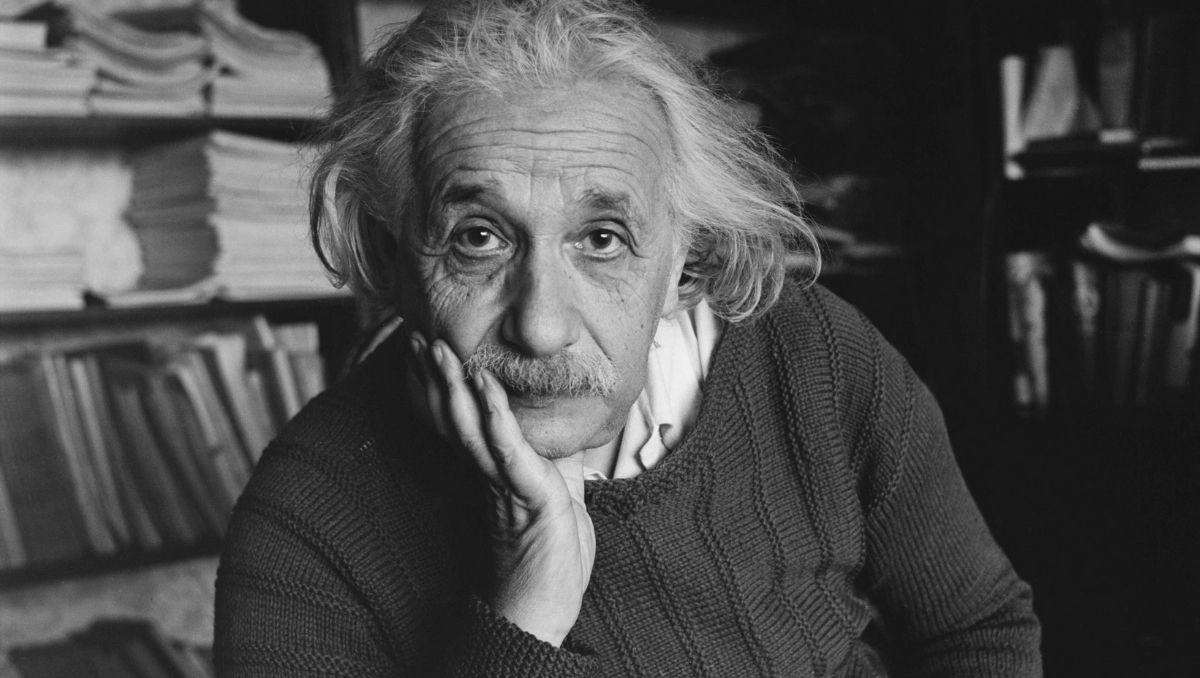

March 14 is marking the 143rd birth anniversary of Nobel Prize winning physicist Albert Einstein. However, not many know that this day is also commemorated as Pi Day.

Albert Einstein (March 14, 1879 – April 18, 1955) was a German-born theoretical physicist. He is best known for his theory of relativity and specifically the equation E = mc², which indicates the relationship between mass and energy (or mass-energy equivalence).
Einstein received the 1921 Nobel Prize in Physics “for his services to Theoretical Physics, and especially for his discovery of the law of the photoelectric effect.”
Albert Einstein was born into a Jewish family in Ulm, Württemberg, Germany. His father was Hermann Einstein, a salesman and engineer. His mother was Pauline Einstein (née Koch). Although Albert had early speech difficulties, he was a top student in elementary school.
In 1880, the family moved to Munich, where his father and his uncle founded a company, Elektrotechnische Fabrik J. Einstein & Cie that manufactured electrical equipment, providing the first lighting for the Oktoberfest and cabling for the Munich suburb of Schwabing.
The Einsteins were not observant of Jewish religious practices, and Albert attended a Catholic elementary school. At his mother’s insistence, he took violin lessons, and although he disliked them and eventually quit, he would later take great pleasure in Mozart’s violin sonatas.
In 1921 Einstein was awarded the Nobel Prize in Physics, “for his services to Theoretical Physics, and especially for his discovery of the law of the photoelectric effect.” This refers to his 1905 paper on the photoelectric effect: “On a Heuristic Viewpoint Concerning the Production and Transformation of Light,” which was well supported by the experimental evidence by that time.
The theory of relativity usually encompasses two interrelated theories by Albert Einstein: special relativity and general relativity, proposed and published in 1905 and 1915, respectively. Special relativity applies to all physical phenomena in the absence of gravity.
Einstein showed that space and time are intertwined in ways that scientists had never previously realized. Through a series of thought experiments, Einstein demonstrated that the consequences of special relativity are often counterintuitive — even startling.
If you’re zooming along in a rocket and pass a friend in an identical but slower-moving rocket, for example, you’ll see that your friend’s watch is ticking along more slowly than yours (physicists call this “time dilation”).
What’s more, your friend’s rocket will appear shorter than your own. If your rocket speeds up, your mass and that of the rocket will increase. The faster you go, the heavier things become and the more your rocket will resist your efforts to make it go faster.
Einstein showed that nothing that has a mass can ever reach the speed of light. Another consequence of special relativity is that matter and energy are interchangeable via the famous equation E = mc² (in which E stands for energy, m for mass, and c² the speed of light multiplied by itself).
Because the speed of light is such a big number, even a tiny amount of mass is equivalent to — and can be converted into — a very large amount of energy. That’s why atomic and hydrogen bombs are so powerful.
In 1971, scientists tested both parts of Einstein’s theory by placing precisely synchronized atomic clocks in airliners and flying them around the world. A check of the timepieces after the planes landed showed that the clocks aboard the airliners were running a tiny bit slower than (less than one millionth of a second) than the clocks on the ground.
The disparity resulted from the speed of the planes (a special relativity effect) and their greater distance from the centre of Earth’s gravitational field (a general relativity effect). In 2016, the discovery of gravitational waves — subtle ripples in the fabric of spacetime — was another confirmation of general relativity.
While the ideas behind relativity seem esoteric, the theory has had a huge impact on the modern world. Nuclear power plants and nuclear weapons, for example, would be impossible without the knowledge that matter can be transformed into energy.
And our GPS (global positioning system) satellite network needs to account for the subtle effects of both special and general relativity; if they didn’t, they’d give results that were off by several miles.
Published by – Kiruthiga K
Edited by – Kritika Kashyap