



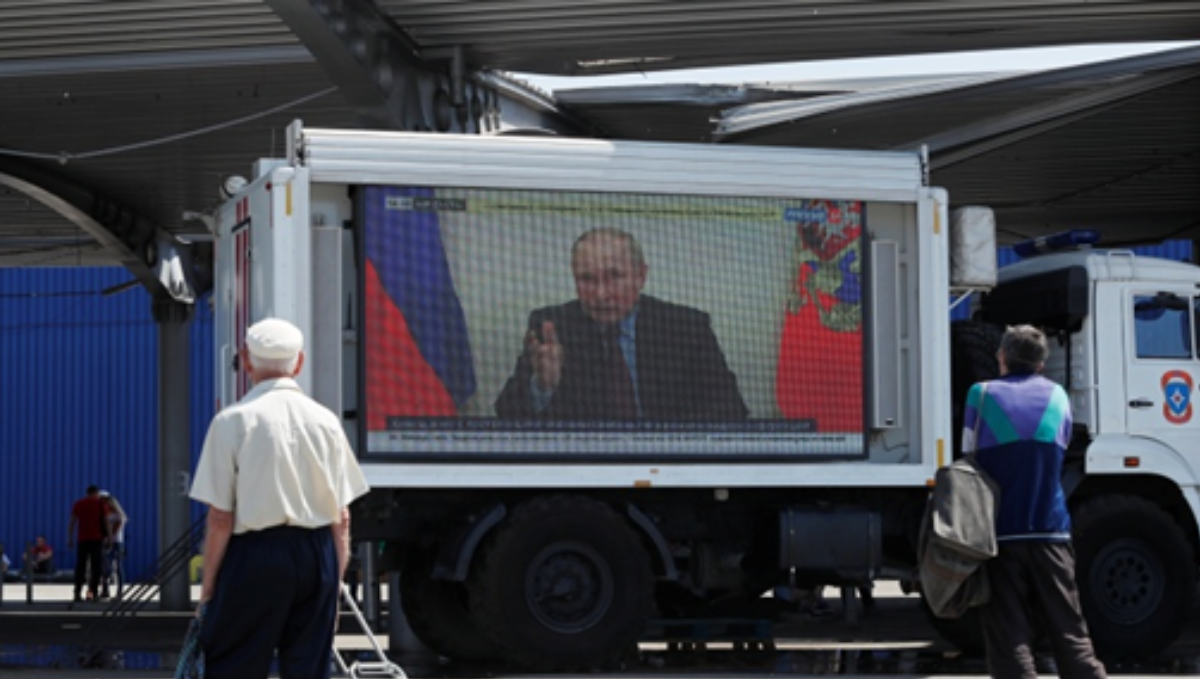

Pro-Kremlin Russian media has been extremely critical of its agenda in portraying Russia’s invasion of Ukraine.
Media can either be a representative of the actual scenario of people, nations, or essential issues or choose to be a mouthpiece of the government authorities, and people with power.
Whether under pressure or choice the kremlin media chose to take the side of Russia in its invasion of Ukraine is not the most important question but, the fact that it is being a chaperon of the Russian government.
This is the illusion of press freedom. Be it media organizations or the Russian news agency TASS. Journalists who are critical of this establishment face censorship and risk it all.
A shift in narrative has been since September 6, when Ukraine began a counteroffensive in the Kharkiv region.
Russian state media has bartered several times throughout the Ukraine crisis. For instance, initially, the media denied the invasion in February to praising and supporting the “ righteous de-Nazification of Ukraine”.
Furthermore, this whole issue is being staged in the background and more airtime is being devoted to entertainment in contrary to persistent coverage during February and march.
According to a recent study, state TV mentions the war less and less while “de-Nazification”, one of the stated goals of Moscow’s “special operation”, barely gets mentioned at all.
On September 6, Ukraine began a counteroffensive in the Kharkiv region, leading to the territorial accession of various regions.
This was followed by a weeks-long Ukrainian disinformation campaign of “leaked, exclusive reports”.
“There is no panic in Balakliya,” the Telegram channel Veteran’s Notes, which boasts 192,000 subscribers, wrote on September 6. In the beginning, pro-Russian bloggers and YouTubers played an important role in shadowing Ukraine’s advances.
“Don’t expect good news today,” Veteran’s Notes warned.
On the other hand, pro kremlin journalist and politician Andrey Medvedev wrote a solemn post.
“It’s been a tough day,” he told his 122,000 readers on Telegram.
“But now it has probably become clearer what it was like for our grandfathers and grandmothers in the Great Patriotic War [WWII] … It will be difficult. Very difficult in places. But we don’t have a choice.”
This very helping and friendly nature of Russian media moved it to avoid outwardly calling out Russian force’s withdrawal from previously held positions as “loss”.
Amid this comes the statement from the ministry of defense spokesperson Igor konashenkov who justifies this decision by saying that the forces would be redeployed from Balakiliia and Izyum in the Donetsk region.
Pro-Kremlin blogger Yuri Podolyaka, meanwhile, described it as an opportunity to regroup.
“The adversary is throwing its main forces into battle,” he told the state-controlled Channel One TV channel.
“Yes, we’ve of course withdrawn to new positions and given up quite significant territories, but if we gather a good force and hit them from the north, Izyum, and the north, our initial problems may turn into big problems for the Ukrainian armed forces.”
The shrewd nature of pro-Kremlin media is evident in its coverage of the proceedings. For example, the state-owned Rossiyskaya Gazeta newspaper made no mention of the gains by Ukraine on Sunday, instead claiming that Ukraine suffered 4000 fatalities between September 6 and 10.
This was further pushed by other pro kremlin commentators that Ukraine’s counteroffensive action is being boosted by outside forces who are supplying weapons and funds to carry on the war.
“Yes, thanks to eight years of efforts by Western countries, the Ukrainian army has become more combat-ready. But by no means immortal,” war correspondent Alexander Simonov, of the Russia-funded Federal News Agency, wrote on the Kharkiv advance.
A very important question that stays is whether or not this positive coverage of Russia’s invasion will have an impact or not.
Initially, there were reports that the Russian population protected against the action of its government which was muted by the media.