



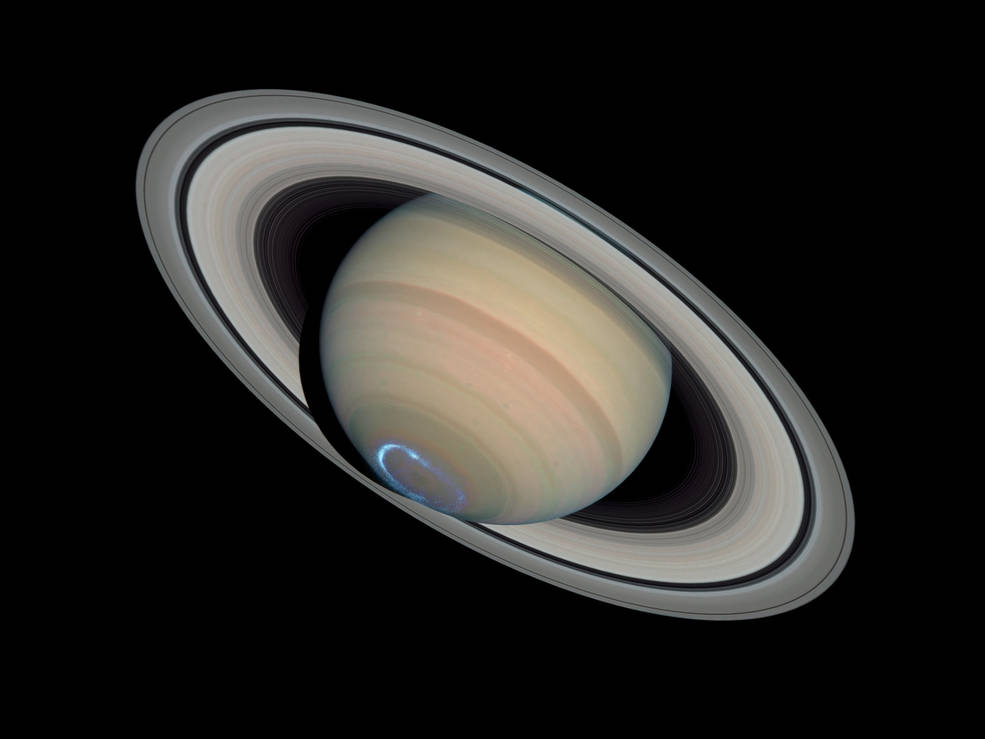

The James Webb Space Telescope has released images of Saturn it captured on June 25. The turning of Webb’s mirror to Saturn is a first.
The images captured by Webb’s Near Infra-Red Camera (NIRCam), makes the gas giant Saturn appear in deep dark orange while its icy rings can be seen shining. Since methane particles in the planet’s atmosphere absorb almost all of sunlight, the planet appears extremely dark in the infrared.
Dione, Enceladus, and Tethys- few of Saturn’s moons are also seen in the images.
Exploring the Wonders
According to scientists, Enceladus is one of the most promising locations to search for life since it harbors a water ocean under a global ice shell. With the help of James Webb Space Telescope, researchers were able to find a large plume jetting from southern pole of the moon. This is a possible source of E-ring’s water molecules.
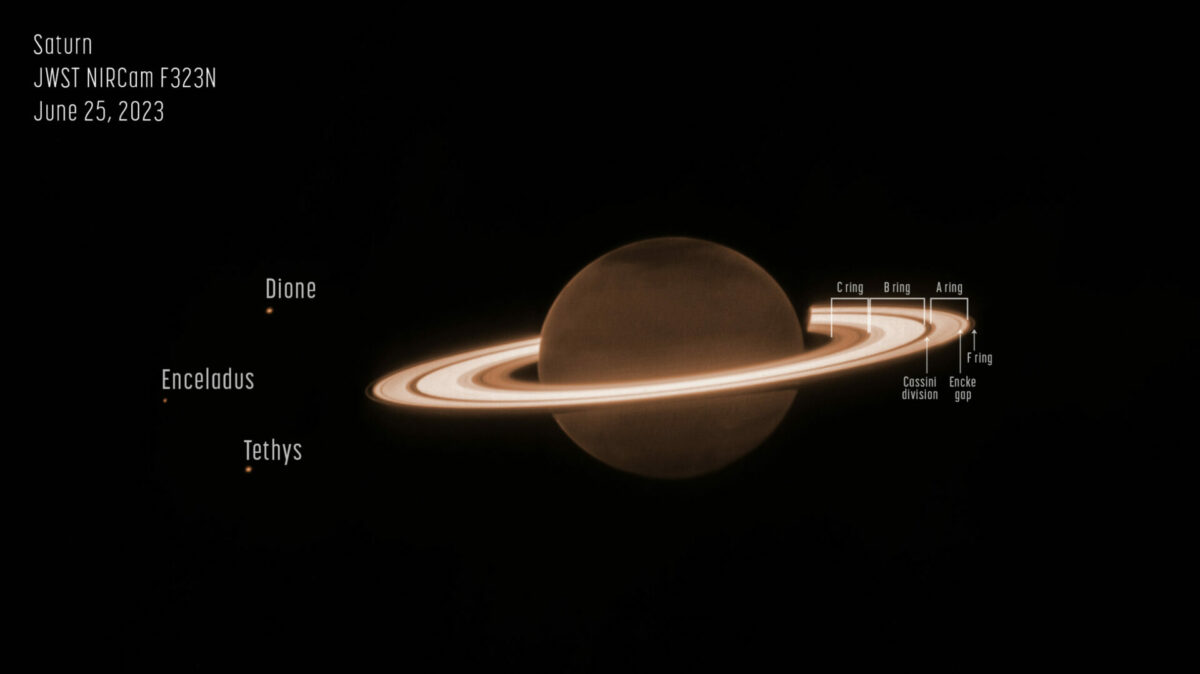
The Cassini spacecraft which explored Saturn for thirteen years was able to observe the planet’s atmosphere at greater quality. But this is the first time to see planet’s atmosphere with clarity at a wavelength of 3.23 microns.
The differences observed for the northern and southern poles of the planet from the images indicate the known seasonal changes of the planet. But the northern pole was found to be particularly dark. As of now, it is believed to be due to unknown seasonal process affecting polar aerosols.
NASA’s Pioneer 11, launched in 1973, Voyagers 1 and 2, launched in separate months in 1977, and Cassini spacecraft have also contributed to observing Saturn.
Saturn’s rings
The rings of Saturn, the most extensive ring system of any planet in the solar system, are made up of an array of rocky and icy fragments. As per the data from the spacecraft Cassini, the rings were formed relatively later.
The researchers will probe some of the planet’s fainter rings which are not visible in the image, including the thin G ring and the diffused E ring by additional deeper exposures.
The images were taken as part of the Webb Guaranteed Time Observation Program 1247.
The James Webb Space Telescope is NASA’s flagship infrared space observatory, developed in partnership with European Space Agency (ESA) and Canadian Space Agency (CSA). It was launched on December 25,2021. It began science operations in July 2022.
Currently, NASA’s Dragonfly spacecraft is scheduled to launch in 2027. It will focus on Titan (Saturn’s largest moon) exploration.